
STYLE HISTORY · INTERIOUS JOURNAL
Arts & Crafts: From Britain to American Craftsman
Arts & Crafts began as a critique of industrial production, but it became something larger: a way of thinking about materials, making and the relationship between a building and the life inside it. When those ideas crossed the Atlantic, they helped shape a distinctly American architectural language.
Arts & Crafts is often recognised through oak furniture, visible joinery, hand-blocked pattern and a preference for natural materials. But treating it as a catalogue of motifs misses the point. The movement began in late-Victorian Britain as a reaction to the social and aesthetic consequences of industrialisation. Its leading voices argued that the way things were made mattered as much as the way they looked.
A reform before a look
In Britain, Arts & Crafts brought together architecture, furniture, textiles, metalwork, glass and the decorative arts. It challenged the separation between designer and maker and questioned an industrial system that could produce more objects, more cheaply, while often stripping the object of material honesty and skilled workmanship.
This is why Arts & Crafts should not be reduced to one fixed visual style. A building can be restrained or picturesque, urban or rural, but the underlying principles remain recognisable: materials should be allowed to look like themselves; construction should make sense; craftsmanship should be visible rather than disguised; and architecture, furniture and decoration should belong to the same whole.
William Morris and the whole interior
William Morris became one of the movement’s most influential figures. His wallpapers and textiles are highly decorative, yet the larger idea behind them was architectural. Pattern was not meant to be pasted onto an unrelated room as an afterthought. Walls, furniture, textiles and objects were parts of a coherent environment.
That distinction still matters. A Morris pattern can be used in almost any contemporary room, but an Arts & Crafts interior is something different. It is created by relationships: the scale of the pattern against the room, the weight of timber against plaster, the profile of a door, the visible construction of furniture and the way repeated details establish rhythm.
For Interious, the useful question is not “does this look Arts & Crafts?” but “do the material, construction and proportion speak the same language?”
Across the Atlantic
Arts & Crafts ideas travelled quickly. In the United States they met different materials, landscapes, production methods and domestic habits. Gustav Stickley was especially important in translating the movement for an American audience. Through his furniture workshops and The Craftsman magazine, he promoted straightforward construction, simple lines, good materials and an integrated approach to the home.
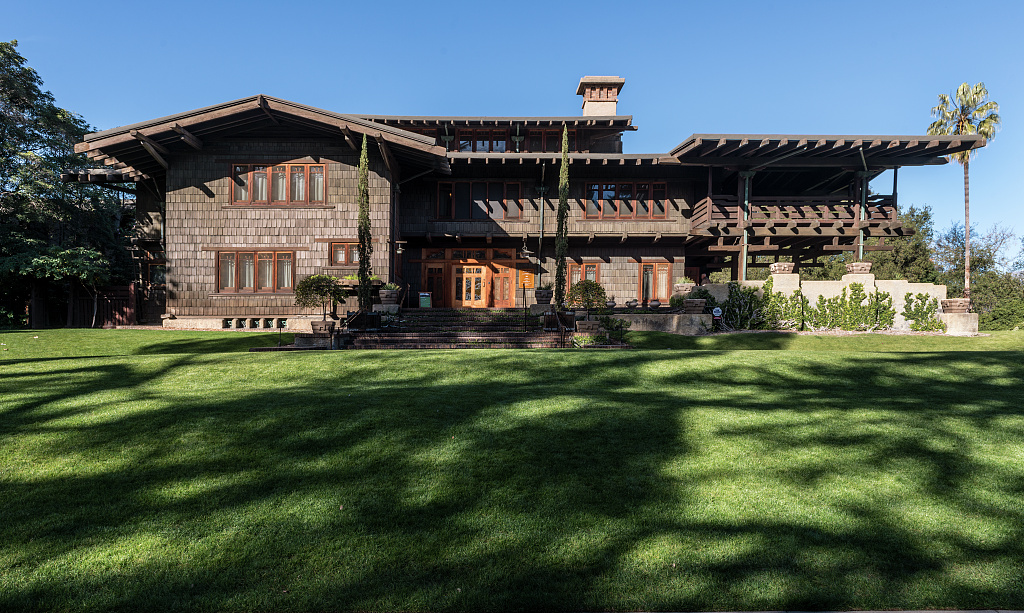
The result was not simply British Arts & Crafts copied in America. The ideas changed. American Craftsman architecture developed its own vocabulary: broad roofs and overhanging eaves, strong horizontal lines, exposed structural elements, generous porches, built-in furniture and an emphasis on timber, masonry and the relationship between house and landscape.
This transformation is central to the Interious idea of connected histories. Styles are rarely sealed national products. They move through books, exhibitions, migration, commerce and education, then change when they encounter a new place.
When Craftsman became architecture
The Gamble House in Pasadena, designed by Charles and Henry Greene in 1908–09, shows how far the American interpretation could develop. Structure, joinery, furniture, stained glass and landscape were conceived as parts of one composition. The house is unmistakably American, yet its debt to the broader Arts & Crafts search for honest materials and integrated design is clear.
That is also why “Craftsman” should not be used as a loose label for every early-twentieth-century house with dark timber. The strongest examples combine massing, roof form, openings, materials and interior detail. A single decorative feature cannot establish the style on its own.
How to recognise the language
When assessing an Arts & Crafts or Craftsman building, start with the building rather than the decoration. Look at the roof and overall proportions. Then read the relationship between windows, doors and wall surfaces. Notice whether structure is expressed or concealed, whether materials are used naturally, and whether repeated details share the same scale and geometry.
Inside, doors, architraves, fireplaces, built-ins, hardware and lighting can be especially revealing. These smaller components often survive even after kitchens, bathrooms and colour schemes have changed. They are useful evidence when trying to distinguish an original architectural language from a later interpretation.
For a broader method, see How to Read Architecture and Architectural Details.
Why it matters now
Understanding the movement does not mean turning a home into a period room. A contemporary intervention can be completely appropriate if it understands the hierarchy of the existing architecture. Equally, a supposedly “traditional” replacement can feel wrong when its proportions, finish or material are inconsistent with the building.
The objective is coherence, not costume. Preserve original evidence where it survives. Where something must be replaced, first understand what role it played in the composition. Then decide whether the right response is historically correct, architecturally appropriate or deliberately contemporary.
That approach sits at the heart of Architectural Correctness: history as a tool for making better decisions, not as a rulebook that freezes a house in time.
Sources & further reading
The historical framework for this article draws on material from the Metropolitan Museum of Art on the Arts and Crafts movement in America and its discussion of Gustav Stickley, as well as collection research on William Morris. The Gamble House image is from the Carol M. Highsmith Archive at the Library of Congress; the Library states that there are no known restrictions on publication.
The Met — William Morris, Wild Tulip
The Met — The Arts and Crafts Movement in America
Library of Congress — The Gamble House in Pasadena